Virginia Woolf |
To the Lighthouse
(το θε λιγηθούσε)
The novel is divided into 3 separate parts, including:
The Window, Time Passes and The Lighthouse.
These are fragmented into stream of consciousness narratives from different narrators.
The first begins just before the start of WW1, at the Ramsay's summer home in Scotland, where a lighthouse stands across the bay.
Here is a breakdown of events from the first section of the novel:
The Window:
- family conflict between 6yr old James and his father
- the family host a number of guests; Charles Tansley (who is in admiration of Mr Ramsays metaphysical philosophy), Lily Briscoe (the painter), Paul and Minta, who arrange to be married
- Mr Ramsay qualms over his shortcomings as a philospher
- There is tension at the dinner party
- Mrs Ramsay ponders the concept of time, reflecting that the dinner party has already slipped into the past.
Time Passes:
- Here time passes more quickly
- Mrs Ramsay dies suddenly
- Andrew Ramsay is killed in battle
- Prue dies from an illness connected with child birth
- The summer house falls into a state of disrepair (weeds and spiders)
- 10 years pass until the family return again, to restore order into their beloved escape

The Lighthouse:
- War breaks out over Europe
- This sections narrative style is similar to section one, in its slow detail and shifting points of view
- Mr Ramsay professes he would like to journey to the lighthouse, though he gets into a temper when this is delayed
- Lily attempts to finish the painting she started on her last visit
- despite James's resentment to his father they have a moment of connection as the boat reaches its destination
- Lily is satisfied with her finished painting.
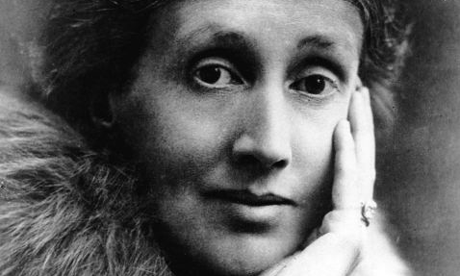
To understand Woolf's writing it is important to read a little of the context, the events that carried out and influenced her writing. Born into a prestigious literary family (her father the editor of 'The dictionary of national biography', and her mother the daughter of William Thackeray). Woolf, though extraordinary and succesful, experienced mental instability throughout her life.
She wrote for the 'Times Literary Supplement' and later found herself at the centre of the 'Bloomsbury Group'. Within this, the inspirational writers artists and Philosophers celebrated nonconformity, aesthetic pleasure and intellectual freedom. By the mid 1920's Woolf had published her most famous novels including To The Lighthouse- reaching the pinnacle of her profession.
Similar to the plot in 'Time Passes', her parents died when she was young, leaving her subject to mental illness, intense headaches and emotional breakdowns. In 1904, after her fathers death, Woolf attempted suicide by throwing herself out of the window (remember Sue in Jude the Obscure?). She married Leonard Woolf in 1912, but was never entirely satisified romantically or sexually, and after an intimate relationship with another woman, (Vita Sackville-West) Woolf became terrified of another breakdown, and to avoid this trauma, for herself and her husband, drowned herself in the River Ouse.
 |
| Vita Sackville-West |
Work:
Her work, written in an elegant, poised style, reflects her literary pedigree. It often celebrates the themes that occupied the Bloomsbury Group, such as feminism, aestheticism and independence, addressing issues contemporaneous to her era, examining the structures of human life (nature of relationships and experience of time).
Stream of Consciousness- this style was influenced by and responded to the work of Joyce, Marcel Proust and Henri Bergson (fr). In 'To the Lighthouse', the passage of time is portrayed through the consciousness of the characters, rather than the clock. A single afternoon takes up half the book where, the following ten years take place in a few pages. The modernist fiction is quite hard to read, the language is dense, and compared to the prior Victorian novels have little action, with most taking place in the characters minds.
The experimental nature reflects the attitudes at the fin de siecle, a time that we previously noticed is a time of great social change and scientific upheavel. (Darwin undermined universal faith in God, Freud introduced psychoanalysis, and with it the unconscious mind).
To the Lighthouse is her most autobiographical work, with many of the characters based on her family.
This is a short documentary, useful if you want to know more about the lovely Mrs Woolf.
This is a short documentary, useful if you want to know more about the lovely Mrs Woolf.
Alternatively here is a recording of her voice, as it is always interesting to know what accent she thought in when writing her novels.

No comments:
Post a Comment